
The Argo story is useful because it shows delivery and workflow orchestration tools gradually becoming a platform layer of their own.
In real design work, the chapter shows when Argo CD, Workflows, Rollouts, and Events form a coherent system for CI/CD and runtime automation, and when that combination starts to overcomplicate the platform stack.
In interviews and engineering discussions, it adds concrete context for discussing the cost of a controller ecosystem: custom resources, upgrade strategy, observability, and the operational maturity the team needs.
Practical value of this chapter
Design in practice
Connect Argo CD, Workflows, Rollouts, and Events into one platform story for CI/CD and runtime automation.
Decision quality
Choose only the Argo components your context needs to avoid stack over-engineering.
Interview articulation
Show how GitOps tooling evolved and which real engineering pain points it solves.
Trade-off framing
Evaluate ecosystem cost: CRD operations, upgrade strategy, and controller observability requirements.
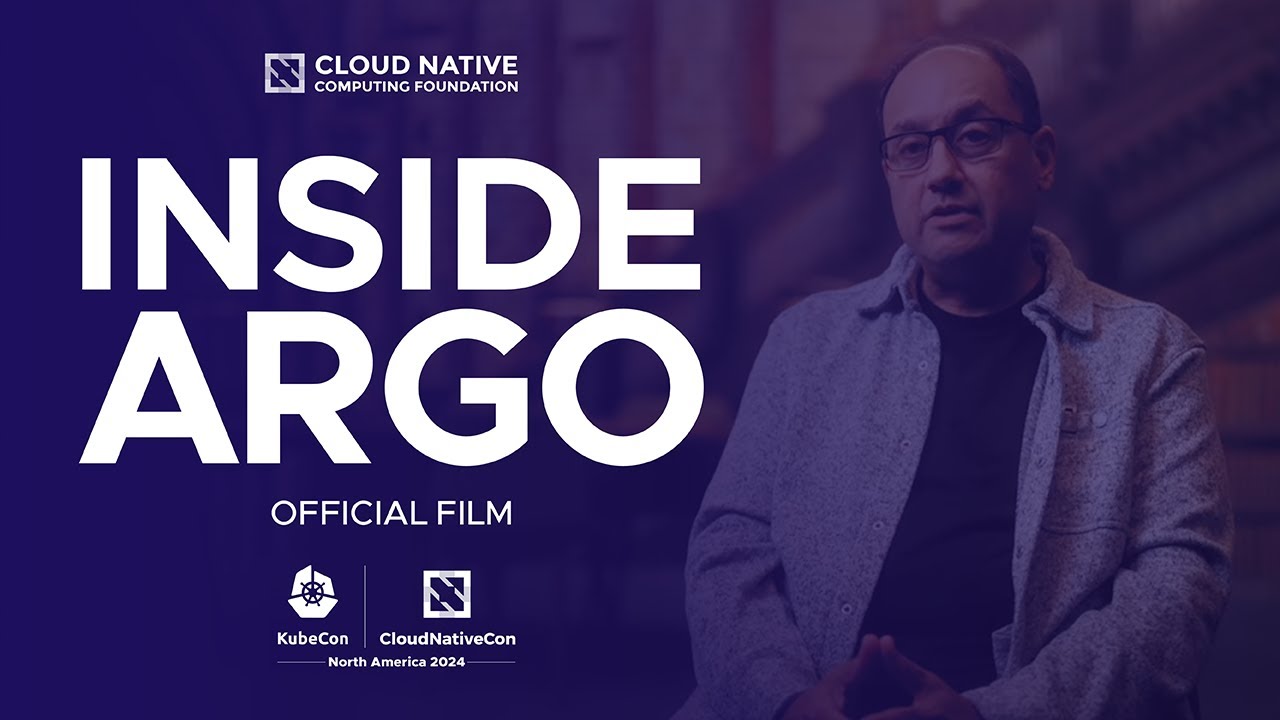
Inside Argo: Automating the Future
A documentary about how Argo grew from a workflow engine into an ecosystem for GitOps, progressive delivery, and Kubernetes automation.
Source
Argo | CNCF
Official project card with key maturity and ecosystem milestones.
Evolution of the Argo project
Creation and open source release
Argo is created by the Applatix team and released as an open source project.
Applatix joins Intuit
After the acquisition, a larger sponsor stands behind the project, and the tool ecosystem keeps growing.
Expansion beyond Workflows
Argo grows into a tool family; BlackRock's contribution to Argo Events strengthens event-driven automation.
CNCF incubation
The project is accepted into the CNCF at the incubation level.
Argo Rollouts 1.0
Progressive delivery with canaries, blue/green releases, and analysis becomes a mature part of the Argo ecosystem.
CNCF graduation
On December 6, 2022, Argo reaches CNCF graduated project status.
Argo CD v3
The new major version of Argo CD focuses on scalability, security, and operating large installations.
Executive summary for practice
For developers
The main engineering shift is moving away from imperative "run these commands on the cluster" to a declarative model where changes flow through Git and reconciliation pulls the cluster toward the desired state.
For tech leads and platform teams
Argo provides a modular platform on which delivery can be brought to one standard: CD, progressive rollout, batch and ML workflows, event automation — and one operating loop instead of scattered scripts in every team.
Key insights from the film and ecosystem
GitOps as an operating discipline
As long as deployment rides on manual procedures, no one can state the cluster's real state with confidence. Git, declarative manifests, and continuous reconciliation move delivery into a predictable lane and leave a transparent audit trail: you can see who changed what.
Argo as an ecosystem, not one product
Argo is not a single tool but a bundle for different job classes: application delivery, progressive releases, batch and ML workflows, event automation. The price of that choice is that you have to know which component covers your case and resist pulling in the whole set where one would do.
Progressive delivery reduces release risk
Ship to everyone at once and you learn about the problem from your users. Canaries, blue/green releases, metric gates, and automatic rollback narrow a release's blast radius and let teams lean on SLOs instead of subjective production health checks.
Community raises production maturity
The Argo story also reads as an argument for open development: contribution to projects and standards such as OpenGitOps directly decides how fast the platform evolves, how resilient it is, and whether you can trust it in production.
Practical implementation steps
- 1Set the OpenGitOps principles first: declarative description, versioning, immutable changes, pull-based deployment, and continuous reconciliation.
- 2Enable Argo CD for one service and practice the PR -> sync -> rollback cycle through Git.
- 3For critical releases, add Argo Rollouts with canaries, blue/green releases, and metric gates.
- 4Move batch and ML scenarios into Argo Workflows instead of keeping one-off scripts in CI/CD.
- 5Connect events and orchestration through Argo Events to automate reactive processes.
What this changes in the operating model
GitOps principles
Git as the source of truth and pull-based deployment
For developers: Repeatable deployments and clearer troubleshooting
For tech leads: Auditable and controlled change management
Metrics: Change failure rate, MTTR, share of PR-based changes
Argo CD
Declarative application delivery in Kubernetes
For developers: Fewer manual emergency fixes in the cluster
For tech leads: One rollout standard across teams
Metrics: Lead time for changes, rollback time
Argo Rollouts
Canaries, blue/green releases, and analysis runs
For developers: Safer rollout of risky changes
For tech leads: Controlled release blast radius
Metrics: Errors and latency during releases, automatic rollback rate
Argo Workflows
DAGs and steps for CI, data, and ML tasks
For developers: Less glue code and fewer shell pipelines
For tech leads: A shared workflow platform
Metrics: Execution time and pipeline stability
Risks and limitations
- GitOps requires strict access discipline and immutable change history; bypassing the PR process quickly becomes an operational risk.
- Progressive delivery adds custom resources and metrics integrations, so platform complexity increases.
- Automatic rollback is only as good as the signals under it: on noisy metrics and without quality gates it either stays silent during a real problem or rolls back a healthy release.
References
- Argo | CNCF project page
- Argo rollouts 1.0 released (CNCF blog, 2021)
- Argo CD v3 update announcement (CNCF, 2025)
- YouTube — Inside Argo: Automating the Future
- Sched — World Premiere @ KubeCon NA 2024
- CNCF News — Inside Argo documentary announcement
- The Linux Foundation — KubeCon NA experience page
- The Linux Foundation — KubeCon India experience page
- OpenGitOps principles
- Argo CD docs
- Argo Rollouts docs
- Argo Workflows docs
Related chapters
- GitOps - Practical next step after the film: how to run pull-based deployment, reconciliation, and rollback in production.
- Kubernetes Fundamentals (v1.36): architecture, objects and baseline practices - Core Kubernetes platform model behind Argo CD, Rollouts, and the rest of the GitOps toolchain.
- Kubernetes Patterns (short summary) - Platform engineering patterns that complement delivery and automation practices shown in the Argo ecosystem.
- Why know Cloud Native and 12 factors - Cloud-native context: why declarative workflows, automation, and standardization become an operational baseline.
- Service Mesh Architecture - Continuation of platform operations topics: traffic management, mutual TLS authentication, and policies in Kubernetes.
- Infrastructure as Code (IaC) and Terraform - Where the line falls: Argo keeps applications in Git, but who keeps the infrastructure and environments? This chapter is about extending the GitOps approach down to that level.