
The Borland story matters because it shows that a language, compiler, and development environment can build not just a product, but an entire engineering empire. Turbo Pascal and Delphi were platforms around which development style, IDE expectations, and professional identity formed for many teams.
The material is especially strong because it shows both sides of platform success. On one side, a strong toolchain creates an ecosystem, retains developers, and accelerates delivery; on the other, strategic turns and market mistakes can quickly narrow even a very strong technical advantage.
In engineering and product discussions, the Borland case is useful for unpacking the relationship between language, development environment, and business strategy. It gives you a concrete way to talk about platform dependence, compatibility, and why engineering strength alone is not enough when a company misses the next major market shift.
Practical value of this chapter
Design in practice
Connect Borland to the full developer path: language, compiler, IDE, components, documentation, upgrades, and migration.
Decision quality
Evaluate the platform through feedback speed, ecosystem strength, backward compatibility, and owner-dependence risk.
Interview articulation
Structure answers as fast tooling, mass adoption, ecosystem, market shift, strategic turn, and legacy.
Trade-off framing
Make the cost of acceleration explicit: a strong IDE and components create productivity, but need migration paths and compatibility protection.
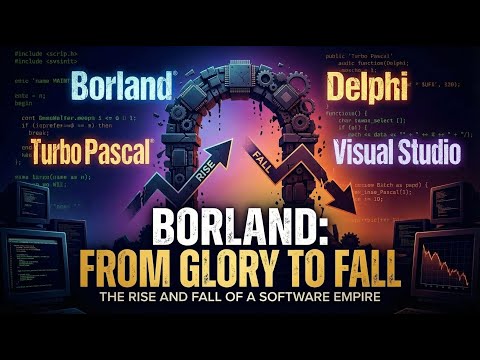
Borland: Turbo Pascal, Delphi, and the History of an Engineering Empire
A fast developer path, a strong IDE, and a well-timed language gathered a whole engineering ecosystem around Borland. The rest is a story about the cost of losing focus: when the market turns, accumulated strength does not save a company that answers too late.
Source
Video about Borland
The rise and decline of Borland: Turbo Pascal, Delphi, RAD, and the company's strategic turns.
Related topic
C# & TypeScript - History of languages with Anders Hejlsberg
The continuation of Anders Hejlsberg's story after Borland and his influence on C# and TypeScript.
What the film is about
At the center of the Borland story are Philip Kahn and Anders Hejlsberg. Their bet on compilation speed, an integrated IDE, and accessible tools shaped developer expectations for decades: a good tool should not merely run, but shorten the path from idea to working application.
Turbo Pascal and Delphi showed that markets are not won by marketing and platform-owner scale alone. The decisive factor can be the engineering quality of a product that genuinely accelerates programmers and gathers a community around itself — and the community then keeps the product alive longer than any ad campaign.
For system design, this is a platform-risk story. A strong tool creates lock-in, ecosystem value, and trust, but there is a bill to pay: without clear strategy, backward compatibility, and readiness for the next market turn, that same dependency becomes a trap for the company itself.
The anchor concepts for this chapter are developer tooling, integrated development environments, compiler speed, Turbo Pascal, Delphi, rapid application development, visual designers, Object Pascal, platform lock-in, backward compatibility, migration paths, and strategic turns. Borland's core signal: a language and IDE turn into an engineering platform when they sharply lower the everyday cost of changing code — not when they add one more feature to the list.
Borland Architecture Map
Borland is best read as a combination of language, compiler, IDE, libraries, and market timing. The company won when the developer path was short and coherent, but lost ground when strategy lagged behind platform shifts.
Borland's value lived in the whole development loop
Turbo Pascal and Delphi sold more than a language: they shortened the path from idea to running application.
Core
The language shapes the mental model
Pascal and Object Pascal were understandable enough for teams to learn quickly and maintain application code.
Speed
Fast compilation shortens the change loop
Developers test ideas more often because build waiting does not break the flow of work.
Environment
The IDE keeps editing, build, and debugging together
The tool becomes a workplace, not a scattered set of commands and files.
Ecosystem
Libraries and components speed reuse
The more ready-made blocks surround the platform, the more expensive it becomes for a team to leave.
Result
Working applications appear faster
A platform wins when it shortens the path to a product, not when it merely adds language features.
Architecture meaning
What to design
- A short loop from change to feedback.
- A coherent language, IDE, library, and build path.
- A migration path if the platform or market shifts.
Why Borland matters for engineering culture
The short development loop as product strategy
Borland won precisely when compilation speed, the IDE, documentation, and pricing together cut the friction between idea and running program. The moment any one of those levers weakened, the advantage faded.
Developer tools as a platform
Turbo Pascal and Delphi were sold not as isolated applications but as developer tools: books, components, practices, and specialist markets grew around them. That layer, not the binary itself, kept users in place.
Compatibility preserves trust
The more code and skill accumulate around a platform, the more each break costs: backward compatibility and a clear migration path stop being a convenience and become the condition under which the community stays.
Engineering strength cannot replace market timing
A missed strategic inflection point hurts even a strong product: the shift to Windows, .NET, the web, or a new delivery model opens a window only briefly, and arriving late costs more than any technical rework.
Key stages
Founding the company and betting on development speed
The company starts as Market In Time, then becomes Borland. Philip Kahn enters leadership and sets the main direction: give developers a fast, convenient “code → compile → run” loop.
Turbo Pascal: the product that changed the market
Turbo Pascal ships with the idea of an integrated development environment and a very low price. Compilation in seconds and accessibility for a broad audience turn it into a hit.
Turbo line expansion and rapid growth
Borland builds tooling around Turbo C, Turbo Assembler, and other products, strengthens its developer brand, and shows that IDE convenience can be a competitive advantage.
Entering databases and growing organizational complexity
The Paradox and Ashton-Tate acquisitions expand the company's ambition, but they also increase operational complexity and create conflicting product strategies.
A difficult transition to Windows
ObjectVision fails to meet market expectations: the product is perceived as limited and expensive. The community needs a stronger answer to the market transition toward graphical interfaces.
Secret Delphi development and a new Borland peak
Borland starts building a new tool for Windows, and Delphi 1.0 ships in 1995. Rapid application development, a visual form designer, and compiled Object Pascal return Borland to the front of development tools.
Leadership break and strategy change
After Philip Kahn and Anders Hejlsberg leave, the company loses strategic momentum. Pricing changes, and the mass-market audience narrows.
Moving toward ALM and fighting for relevance
Borland focuses on application lifecycle management, while the IDE business loses priority. As .NET and Visual Studio grow, Delphi's influence gradually declines.
CodeGear, the IDE sale, and the end of independent Borland
Development tools are separated into CodeGear and sold to Embarcadero. Borland is later acquired by Micro Focus, ending the era of the independent company.
The Embarcadero era: Delphi and RAD Studio live on
After the CodeGear deal, the product line evolves under the Embarcadero brand: RAD Studio XE/XE2/XE3 and later versions ship, the platform gains a new release cadence, and cross-platform focus expands.
A new owner for the IDE business: Idera
Idera announces the acquisition of Embarcadero in October 2015 and reinforces the focus on developer tools. The Embarcadero brand remains, and Delphi/RAD Studio stay at the center of the product line.
Borland's ALM legacy moves into OpenText
OpenText closes the Micro Focus acquisition on January 31, 2023, and the corporate branch that previously included Borland becomes part of a larger enterprise software portfolio.
The modern Delphi/RAD Studio stage
RAD Studio 12 Athens ships in November 2023, followed by RAD Studio 13 Florence in September 2025. The engineering line that began with Borland and Delphi is still moving decades later.
What matters for system design
Focus beats a broad product line
Borland grew while its strategy was clear and developer-centered. Once attention spread across IDEs, databases, ALM, and office products, strategic drift set in — and every new direction drew effort away from the core.
Developer experience is a business metric
Accessible pricing and a strong developer experience can drive faster growth than expensive enterprise positioning. Convenience for the engineer is not image here; it is a direct revenue driver.
Ecosystem matters more than feature count
A competitor can catch up on features in one release, but not on a language ecosystem — components, examples, community. That is what keeps a platform afloat even after ownership changes.
Competing with a platform owner requires differentiation
When Microsoft strengthens Visual Studio and .NET, it is not enough for an independent tool to be good. It has to answer clearly why a team is better off staying with it rather than defaulting to the platform owner.
Platform lock-in must be intentional
Lock-in is not a verdict, but its price has to be named up front: exactly what is tied to the IDE, components, libraries, language, and product owner — and what each of those knots threatens when ownership changes.
Engineering leadership is part of architecture
Losing key people rewrites more than the roadmap. The culture of quality, the stance on compatibility, and the habit of listening to the community leave with them — none of it written down anywhere, and all of it slow to rebuild.
How to apply Borland's lessons today
Keep product strategy stable
Every change of direction costs teams and users some trust, so it should be rare, explained, and tied to a clear market change — not to yet another reshuffle of the portfolio inside the company.
Design the whole developer path
Build speed, diagnostics, documentation, examples, upgrades, and entry cost work as one loop: a weak link at any point breaks the feel of the whole product, however well the rest is built.
Protect the business core
Before moving into an adjacent area, check that the core product is strong and that the new direction reinforces the platform rather than pulling people and attention away. Otherwise the expansion is paid for out of the core's budget.
Plan migrations early
A ready migration path is needed even where leaving the platform is not planned: it removes the fear around upgrades, ownership changes, and market shifts, so teams actually decide to update instead of getting stuck on old versions.
References
The factual base for this chapter is the Borland video and official Idera/Embarcadero corporate materials. Acquisition and modern Delphi/RAD Studio release claims are tied to primary announcements; the conclusions about developer-tool strategy are editorial assessment.
Related chapters
- Evolution of software architecture with Grady Booch - helps place the architectural context of the era in which engineering practice took shape around Borland, Object Pascal, and modeling tools.
- Frontend Architecture for Design Systems - carries the tooling and engineering-productivity line forward: the same ideas grew into modern interface-platform and design-system work.
- C# & TypeScript - History of languages with Anders Hejlsberg - continues Anders Hejlsberg's story after Borland and shows how his approach to languages, IDEs, and compatibility influenced C# and TypeScript.
- IntelliJ IDEA: The Documentary - compares two IDE eras: Delphi/Borland as early RAD and IntelliJ as a modern environment with deep code understanding.