
The conversation with Kelsey Hightower matters because it pulls platform engineering out of slogan territory and back into mature decisions about boundaries and responsibility.
The chapter shows how Kubernetes maturity, API contracts, AI guardrails, and team skills work together where teams need stable interfaces and ways of working more than another tool.
In engineering discussions, it helps you unpack where a platform genuinely speeds delivery, where Kubernetes stops being the goal, and why maturity so often depends on agreements rather than products.
Practical value of this chapter
Design in practice
Turn guidance on platform engineering, API contracts, and engineering culture into concrete operational decisions: alert interfaces, runbook boundaries, and rollback strategy.
Decision quality
Evaluate architecture via SLO, error budget, MTTR, and critical-path resilience rather than feature completeness alone.
Interview articulation
Frame answers around the reliability lifecycle: degradation signal, response, root-cause isolation, recovery, and prevention loop.
Trade-off framing
Make trade-offs explicit for platform engineering, API contracts, and engineering culture: release speed, automation level, observability cost, and operational complexity.
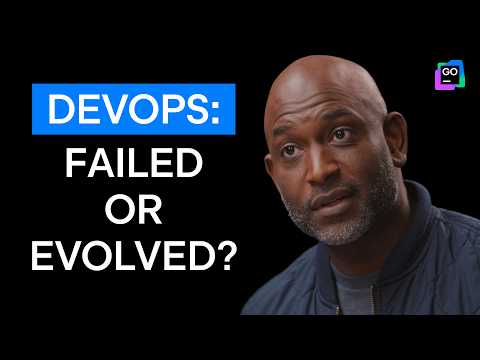
AI, DevOps, and Kubernetes: Kelsey Hightower on What's Next
A 2025 conversation about the state of the industry: where DevOps has shifted, why Kubernetes should drop into the implementation details, and where AI is genuinely useful versus where it is still just hype.
Source
Telegram analysis
Two-part interview analysis with an emphasis on platform engineering, AI, and team skills.
About the episode
The interview is barely about specific tools — it is about how maturely a team handles its platform. Kelsey asks the uncomfortable questions: where rituals persist for their own sake, how to collapse cross-team collaboration into API contracts instead of standing meetings, and why reliable infrastructure is best measured by how rarely you have to think about it.
Guest and context
Kelsey Hightower
- Former Distinguished Engineer at Google.
- One of the best-known educators around Kubernetes and cloud-native practices.
- Author of the hands-on repository Kubernetes The Hard Way.
- Expert in platform engineering, DevOps culture, and operational practices.
5 key themes from the interview
DevOps: an evolution, not a new label
Renaming an admin to an engineer while leaving the same skill set is a change of label, not of approach. DevOps means something else: broader engineering skills, more automation, and accountability for the outcome rather than for your own slice. Skip that and the cost stays the same — the wall between dev and ops just moves inside a single role.
Kubernetes as a predictable foundation
For stateless workloads, Kubernetes is already mature enough to fade into the background. A good sign of that maturity is that the product team barely notices it. When infrastructure instead demands constant attention and on-call heroics, it is not a platform — it is one more system someone runs by hand.
API contracts instead of constant sync meetings
Boundaries between teams are not the problem; the problem starts when crossing one requires a meeting. Back the boundary with a clear contract and repeated operations move to self-service APIs. Every manual handshake is a future queue at one person and a place where delivery stalls.
AI works best inside guardrails
There is a lot of skepticism toward the hype here, and for good reason: LLMs are probabilistic and will sometimes be confidently wrong. The value comes not from the model itself but from the scaffolding around it — clean APIs, documentation, and guardrails that narrow the answer space and make the result verifiable. Without that scaffolding you are left with plausible text and no guarantees.
Team skills are part of engineering
Software engineering is still a team sport, and it is not won by whoever drags in the trendiest stack first. Empathy, discipline, and choosing tools that fit the task beat fashion. That is why communication and team skills are not a resume bonus but part of engineering practice: without them even a good solution never reaches production.
Related chapter
Kubernetes Fundamentals
A foundation for the control plane, workload objects, and the operational minimum of Kubernetes.
Practical takeaways for platform engineering
- Treat platform engineering as a platform-as-product discipline for internal customers: with a clear API contract, not a “ping us in the chat and we will figure it out” arrangement.
- Reduce operational friction: infrastructure should be predictable, not heroic.
- Invest in documentation, interfaces, and contracts: the same text that gets a new teammate up to speed is now the context AI-based tools run on.
- For AI assistants, define guardrails: context, restrictions, data sources, and verifiable quality criteria.
- Build engineering culture through incident reviews, empathy, ownership, and disciplined technology choices.
References
Related chapters
- Cloud Native overview - Provides the platform foundation where Kubernetes and DevOps practices become part of the delivery platform.
- API as a contract - Shows how to turn the idea of an API contract into a working discipline: API-as-product and cross-team contract design instead of constant manual synchronization.
- AI/ML Engineering overview - Extends the interview's AI guardrails topic with practical engineering boundaries for reliable AI usage.