
Clojure is interesting not as a language with parentheses, but as a discipline for fighting accidental complexity. It asks you to think separately about values, identity, state, and time instead of hiding all of that behind convenient syntax.
The chapter shows why simple and easy should not be collapsed into one word. A familiar framework, ORM, or one more service may be easy for the team today, yet make the system less simple a year later through hidden coupling and unmanaged mutation.
For architecture discussions, this film is useful context for managed state, immutable data, pragmatic use of the JVM, and Datomic as an example of the same philosophy applied to facts and historical data.
Practical value of this chapter
Design in practice
Connect Clojure to identity modeling, immutable values, explicit state transitions, JVM integration, and data history.
Decision quality
Evaluate technology through simple vs easy: what lowers system coupling, and what is merely faster because it is familiar.
Interview articulation
Structure answers as state, immutability, concurrency, coordinated change, audit, and operating cost.
Trade-off framing
Make the model's cost explicit: less hidden mutation and more clarity, but a higher bar for onboarding, hiring, and adoption.
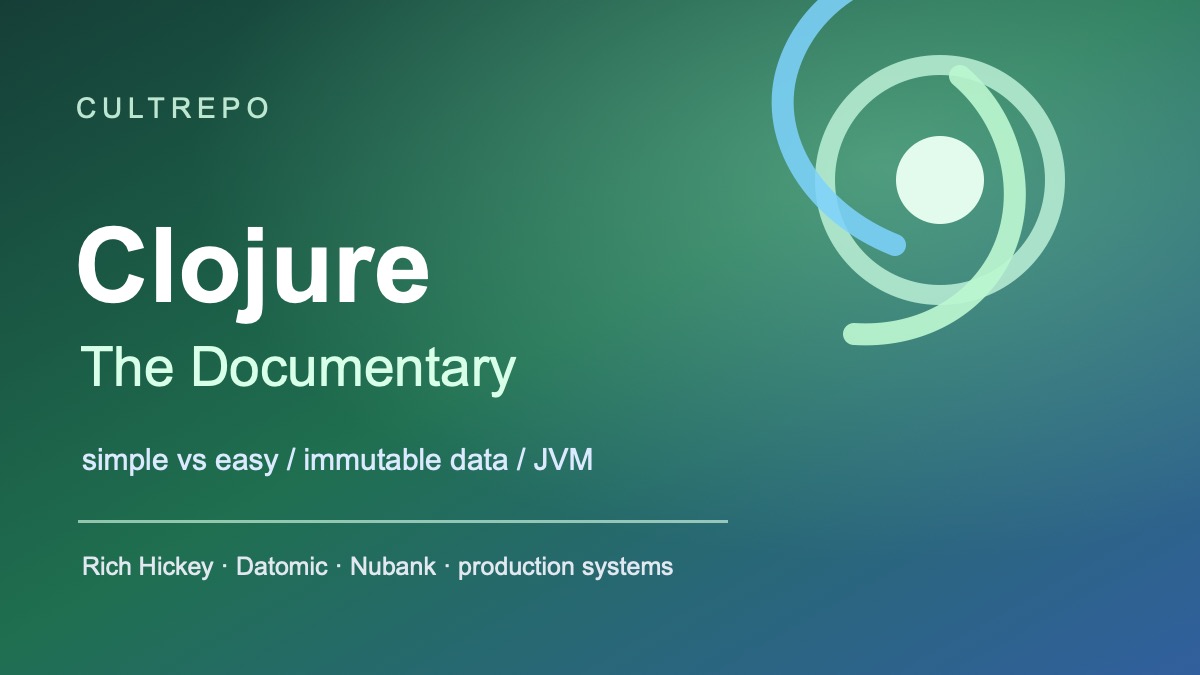
Clojure: The Documentary
The story of a language that turned simplicity, immutable data, and JVM pragmatism into a production stack
Source
Clojure documentary
Official Clojure page with the film, participants, and viewing notes.
What is the film about?
CultRepo's documentary about Clojure is the story of how Rich Hickey's view of complexity became a language, a community, Datomic, and a real production stack for companies such as Nubank. The main character is not Lisp syntax, but a model of thought: immutable data, pure functions, explicit state transitions, and caution around accidental complexity.
That is why the film is worth watching even for engineers who will never write a line of Clojure. It hands any engineering team an uncomfortable question: does your main language and framework help you build systems from simple parts, or do they merely make familiar things more convenient?
Clojure Architecture Map
Clojure is useful to read as a design model: reduce interleaving, separate identity from value, keep state change explicit, and preserve data history where the business needs it.
Simplicity reduces interleaving, not just startup cost
A convenient solution can still be a bad trade if it hides coupling, state, and implicit dependencies.
Flow
The team sees a familiar problem
A framework, ORM, or abstraction layer may feel fast because it is already nearby.
Easy accelerates the first step
Familiarity lowers initial cost, but it does not guarantee a simple system.
Hidden coupling becomes the main risk
The question is how many decisions now have to live and fail together.
Simple leaves fewer things intertwined
Data, functions, state, and effects get explicit boundaries.
Change cost goes down
The system becomes easier to test, evolve, and explain to new teammates.
Key milestones
Clojure becomes a public project
Rich Hickey introduces a Lisp for the JVM designed from the start around functional programming, Java interoperability, and concurrency.
Clojure 1.0
The 1.0 release stabilizes the language core and makes backward compatibility part of the ecosystem's engineering promise.
Simple Made Easy
Rich Hickey's talk sharpens the distinction between simple and easy: familiar convenience does not necessarily reduce coupling in a system.
Datomic carries immutability into data
Datomic makes facts and history central to the data model: the past is not overwritten, but remains available for audit and queries.
Nubank and Cognitect
Cognitect becomes part of Nubank, making Clojure and Datomic even more visible as a production stack in a large fintech company.
Clojure: The Documentary
CultRepo captures the story of the language, community, Datomic, and companies that made Clojure a practical production stack.
Ideas worth taking from the film
A programming language is a way of thinking
Parentheses and the JVM are the most visible thing about Clojure, but not the most important. The language pushes you to assemble programs from simple parts: values, pure functions, explicit state transitions, and fewer hidden dependencies.
Simple and easy are different categories
Easy is nearby and familiar to the current team. Simple has fewer interleavings, hidden dependencies, and sources of accidental complexity.
Identity and state should be separated
Identity can live through time, but a concrete state value remains immutable. The system associates identity with a new value rather than mutating the old one.
Mutable state does not disappear; it becomes managed
Atoms, refs, agents, and STM provide explicit ways to change state. The point is not dogma against mutation, but control over where and how it happens.
Pragmatism matters more than purity
Clojure chooses the JVM as a mature runtime: libraries, performance, tooling, enterprise trust, and access to existing Java code.
Stability is a product feature
Conservative language evolution lowers ownership cost: old code keeps running, and new capabilities do not turn every upgrade into a migration project.
Datomic applies the same philosophy to data
Facts, history, and audit become part of the model rather than a later add-on. That is especially natural in fintech and systems where mistakes are expensive.
People and context
Rich Hickey
creator of Clojure and Datomic
Alex Miller
member of the Clojure core team
Stuart Halloway
author, speaker, and early ecosystem voice
Nubank
large-scale production use of Clojure and Datomic
Cognitect
team around Clojure, Datomic, and engineering practices
What matters for system design
The state model matters more than syntax
In system design, the question is not whether a language looks elegant, but whether it helps express state, transitions, boundaries, and invariants clearly.
Concurrency is easier when immutable data can be shared
If most values can safely be shared between threads, the team depends less on manual discipline around locks.
Data history is not a side effect
Datomic is a reminder that audit, debugging, and investigations often need more than the current row: they need the full sequence of facts.
A platform should age predictably
API stability, conservative change, and compatibility can matter more than the feeling of constant movement when a system lives for years.
A new idea must connect with business reality
Clojure got a chance not merely as a theoretically correct Lisp, but as a language that joined the JVM and could live beside existing infrastructure.
Datomic as Clojure's architectural continuation
In ordinary backend development, systems are often designed as if the past can be erased by an update statement. Datomic offers a different view: data is facts, history matters, and current state is a view over accumulated assertions. For finance, compliance, and analytical systems, that is not academic elegance; it is a way to make audit, debugging, and explanation part of the core architecture.
How to apply Clojure ideas today
Common pitfalls
Recommendations
References
The factual base for this chapter is the film, Clojure.org show notes, rationale/state/concurrency materials, Datomic, and Simple Made Easy. The conclusions about simplicity, data modeling, Nubank, and operational trade-offs are editorial synthesis from those sources.
Simple parts
fewer interleavings, clearer boundaries
Managed state
immutable values plus explicit transitions
Pragmatic platform
a strong idea joined to the existing JVM reality
Related chapters
- Why languages and platforms matter in System Design - sets the broader frame for language choice: runtime, ecosystem, concurrency model, hiring cost, and maintainability.
- Elixir: The Documentary - helps compare two functional stacks where the language shapes thinking about state, failure, and concurrency.
- Node.js: The Documentary - provides a contrasting backend case: event loop, npm, and ecosystem versus JVM pragmatism and an immutable-first model.
- Jepsen: testing distributed systems - connects Clojure to practice: Jepsen is written in Clojure and shows the value of explicit operation histories.
- Database selection framework - places Datomic in the broader storage decision: SLA, history, transactions, ownership cost, and migrations.
- Consistency and idempotency patterns - extends the topic of explicit state transitions, retries, idempotency, and auditable effects.