
Java’s history shows that portability comes from a durable binary contract between a compiler and the JVM, not from a slogan. That layer let one artifact survive changes in processors, operating systems, and generations of server infrastructure.
The chapter connects backward compatibility, the JCP, OpenJDK, JDK vendors, and a mature library ecosystem. It shows why platform governance and compatibility tests become as architectural as the language and runtime.
For system design, Java is especially useful as an operational case: JIT compilation, garbage collection, virtual threads, observability, and dependencies demand measurement and recurring upgrades rather than faith in defaults.
Practical value of this chapter
Design in practice
Set the JDK baseline, vendor, GC, concurrency model, container limits, and boundaries around external resources.
Decision quality
Evaluate the platform through compatibility, warmup profile, observability, library maturity, and upgrade cost.
Interview articulation
Structure answers as bytecode, JVM, JIT/GC, threading model, operational signals, and a migration plan.
Trade-off framing
Make maturity costs explicit: portability and ecosystem speed up delivery but require memory, warmup, and supply-chain control.
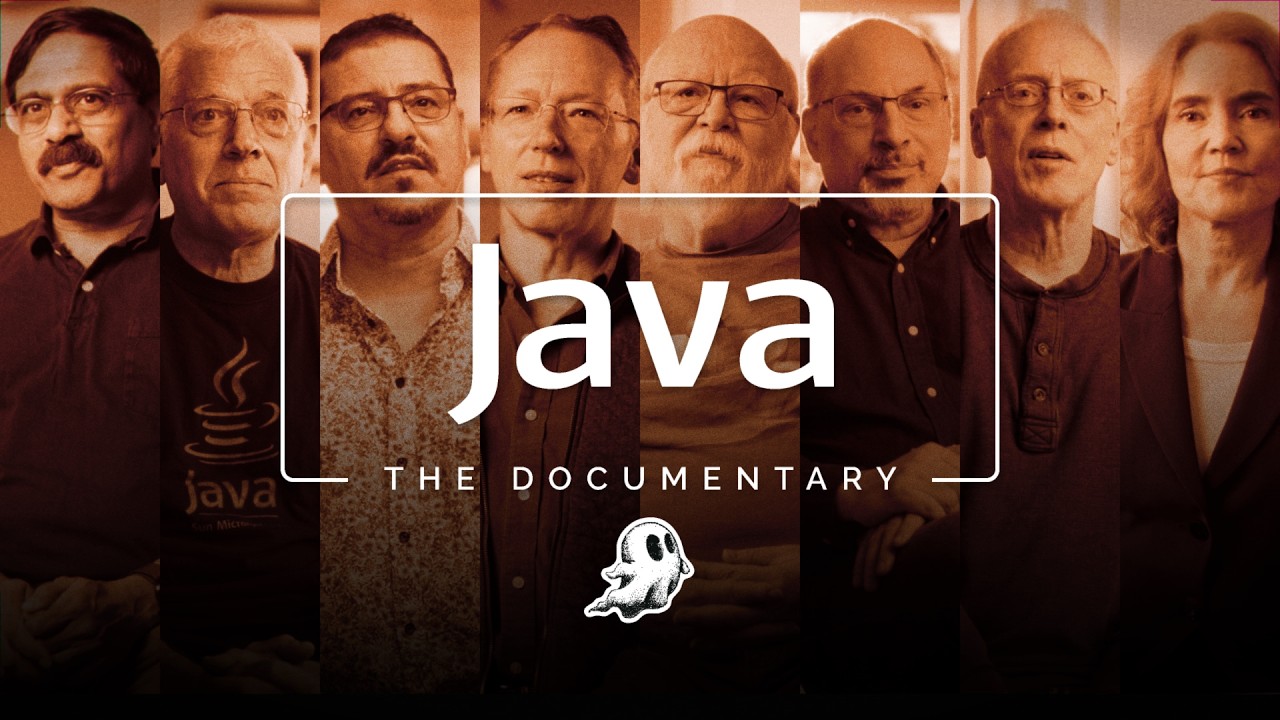 Watch on YouTube
The Java Story | The Official Documentary
The story of Java as a portable binary contract, an open platform, and an ecosystem that outlived changes in ownership, governance, and generations of server architecture.
- Production
- CultRepo
- Premiere
- July 17, 2026
- Runtime
- 1:14:10
- Director
- Joey Bania
- Producer
- Emma Tracey
The film is supported by Oracle, IBM, JetBrains, Azul, and Railway. Forecasts and evaluative claims are therefore separated from facts verifiable through OpenJDK, the JCP, and release documentation.
Primary source
The Java Story | The Official Documentary
CultRepo’s official publication with chapters and the participant list.
What the film is about
The story begins with Project Green and explains why Java’s central invention was not syntax but the boundary between a program and a machine. A class file became a portable artifact, and the JVM became the contract implementation for a specific operating system.
It then expands into platform stewardship: the Microsoft compatibility dispute, the JCP, OpenJDK, the transition to Oracle, and the role of independent JDK vendors. This is a useful account of how organizational mechanisms sustain a technical standard.
For system design, the modern layer is the most valuable: JIT, GC, virtual threads, observability, and a vast dependency graph. Java removes some application complexity by moving it into platform operations.
Key voices in the film
Origins and compatibility
Oak, the Java launch, WORA, and the fight to keep a single compatibility contract.
- James Gosling
- Kim Polese
- Tim Lindholm
- Carla Schroer
Application ecosystem
Tomcat, J2EE, Spring, and Hibernate as responses to the needs of server-side development.
- James Duncan Davidson
- Rod Johnson
- Gavin King
Modern platform and stewardship
OpenJDK, the JCP, the release cadence, and Java as a shared industrial platform.
- Brian Goetz
- Mark Reinhold
- Georges Saab
- Heather VanCura
Historical timeline
Project Green and Oak
Java launches with the WORA promise
The Microsoft compatibility dispute
Java Community Process
Tomcat, J2EE, Hibernate, and Spring
OpenJDK
Java moves to Oracle
Java 8
Modules, a faster release cadence, and Jakarta EE
Virtual threads in JDK 21
The documentary premieres and the next horizon appears
Java Platform Architecture Map
Java is best understood as a set of contracts: languages compile into shared bytecode, the JVM executes it on a concrete platform, and compatibility plus release processes keep the ecosystem together.
Portability starts with a shared format, not identical hardware
Write Once, Run Anywhere works when compilers emit compatible class files and the JVM on each operating system implements the same platform contract.
Source code
More than one language lives on the platform
Java, Kotlin, Scala, and Clojure offer different programming models while sharing JVM libraries and tools.
Build
A compiler translates each language into a shared format
The language front end enforces its own rules, then emits class files with instructions and metadata for the virtual machine.
Binary contract
Bytecode separates the application from the processor
The same artifact can move across compatible JVM implementations without being rebuilt for every CPU architecture.
Execution
The JVM implements the platform contract
The virtual machine loads, verifies, and executes code while providing standard libraries and expected runtime behavior.
Physical platform
The JDK vendor closes the OS and hardware gap
A native JVM still depends on the kernel, architecture, and system libraries, so portability does not remove platform testing.
Architecture meaning
What to verify
- Class-file version and the minimum supported JDK.
- Native libraries, system dependencies, and target CPU architectures.
- The selected JVM build under a representative workload.
What Java changed about platform architecture
Portability is a binary contract
Compatibility is a product capability
The platform matters more than one language
Governance is part of the technical contract
Practical system design takeaways
Measure the entire JVM profile
Virtual threads simplify code; they do not create capacity
Design the upgrade path in advance
The runtime must be observable
Operational trade-offs
Warmup versus peak speed
Automatic memory versus predictability
A rich ecosystem versus a wider risk surface
Portability versus platform details
Platform snapshot: July 2026
JDK 26 is the current feature release and JDK 25 is the current LTS. Virtual threads ship in JDK 21, while the Foreign Function & Memory API was finalized in JDK 22.
Project Valhalla and Project Babylon remain OpenJDK development projects. Their ideas matter to the architecture horizon but must not enter a current design as guaranteed capabilities.
Applying the film’s ideas
Antipatterns
Recommendations
How to watch it productively
Developer
Connect familiar APIs to class loading, JIT, GC, and the actual cost of execution.
Tech lead
Define the JDK baseline, upgrade path, vendor dependency, and migration criteria.
Interview
Explain WORA, compatibility, and virtual threads through constraints rather than slogans.
Sources and claim boundaries
The historical narrative and participant list come from the film. OpenJDK/JCP processes, JEP status, and releases are checked against primary sources. Architecture guidance is editorial synthesis; predictions about AI, Valhalla, and Babylon are not presented as shipped capabilities.
Related chapters
- Languages and Platforms - compare the JVM with other execution models and ecosystems
- Spring Framework - see how server-side Java became an application platform
- Clojure - explore another language model on the same JVM
- IntelliJ IDEA - study the tooling that grew with the JVM ecosystem
- Log4Shell - understand the cost of transitive dependencies and supply-chain risk
- Performance Engineering - turn JIT, GC, and concurrency discussions into a measurable process